Dionne Warwick first imagined “That’s What Friends Are For” as a duet. By the time the song was released in 1985, it had grown into a collaboration among Warwick, Stevie Wonder, Gladys Knight and Elton John—and a benefit for AIDS research.
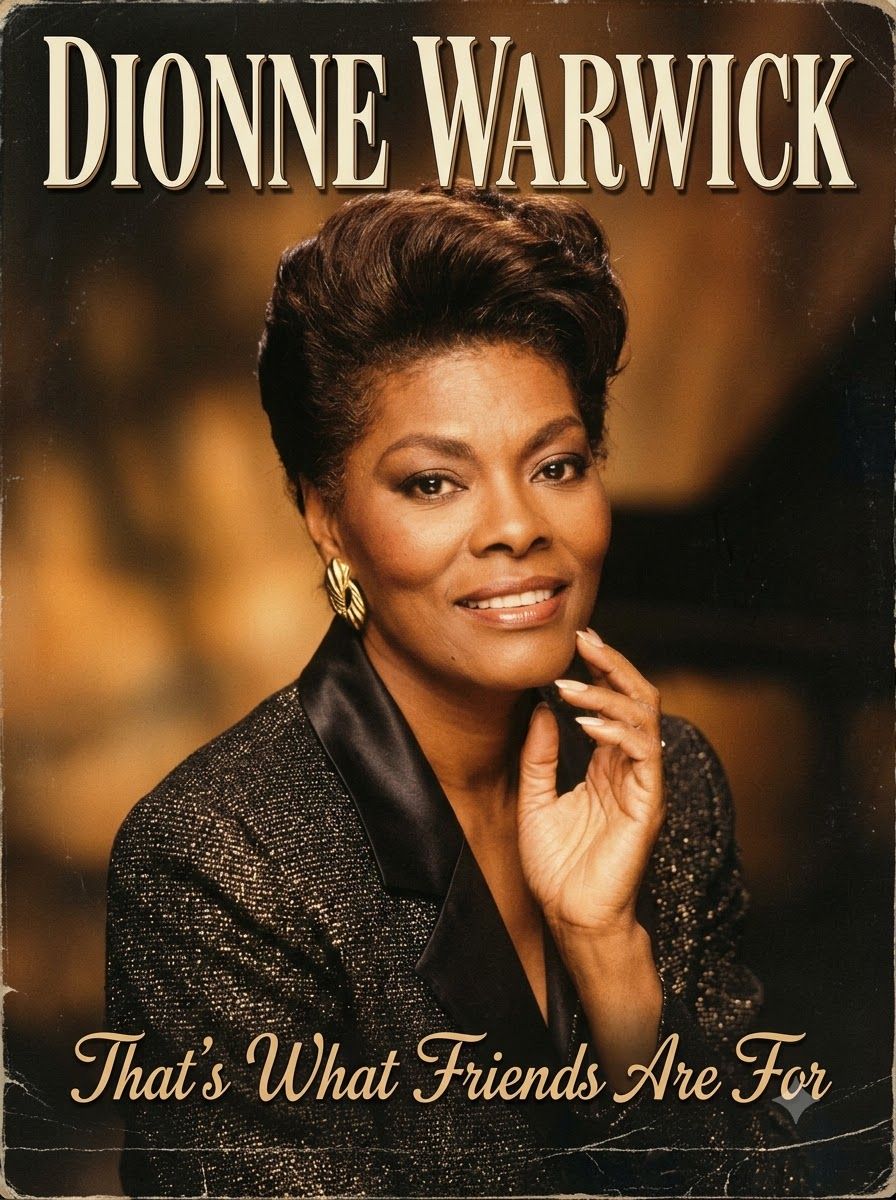
Burt Bacharach and Carole Bayer Sager wrote the song for the 1982 film Night Shift, where Rod Stewart performed it. Warwick returned to it three years later while working with the songwriters, drawn to its direct promise of friendship. Her initial idea was to record it with Wonder.
The project took on a wider purpose during the recording. Actress and AIDS activist Elizabeth Taylor visited the studio, and Bayer Sager later recalled that Taylor’s presence prompted the idea of donating the proceeds to the American Foundation for AIDS Research, or amfAR. The recording brought in Knight and John as well as Wonder, turning Warwick’s duet concept into a four-voice performance.
Released as “Dionne & Friends,” the single paired the singers without making the arrangement feel like a showcase for individual star turns. Warwick’s voice anchors the performance, while the others add contrasting colors and lift. Bacharach and Bayer Sager produced it, keeping the melody clear and the song’s central reassurance in focus.
The single reached No. 1 on the Billboard Hot 100 on January 18, 1986, and held the position for four weeks. Billboard later named it the top single of 1986. At the 1987 Grammy Awards, it won Song of the Year for Bacharach and Bayer Sager, and Best Pop Performance by a Duo or Group with Vocal.
Its impact extended beyond the charts and awards. The artists and songwriters donated the recording’s proceeds to amfAR; the song raised millions for AIDS research and helped draw public attention to a disease surrounded by fear and stigma. Its message of staying beside someone in difficult times was matched by a practical contribution to the cause. That connection between the lyric and the benefit is central to the song’s lasting significance.