In February 1979, Johnny Cash recorded “Ghost Riders in the Sky” at Jack Clement Studios in Nashville, taking on a cowboy ballad that had already traveled a long way through American music. In his version, the tale of phantom riders feels less like a Western adventure than a warning from beyond the horizon.
From folklore to standard
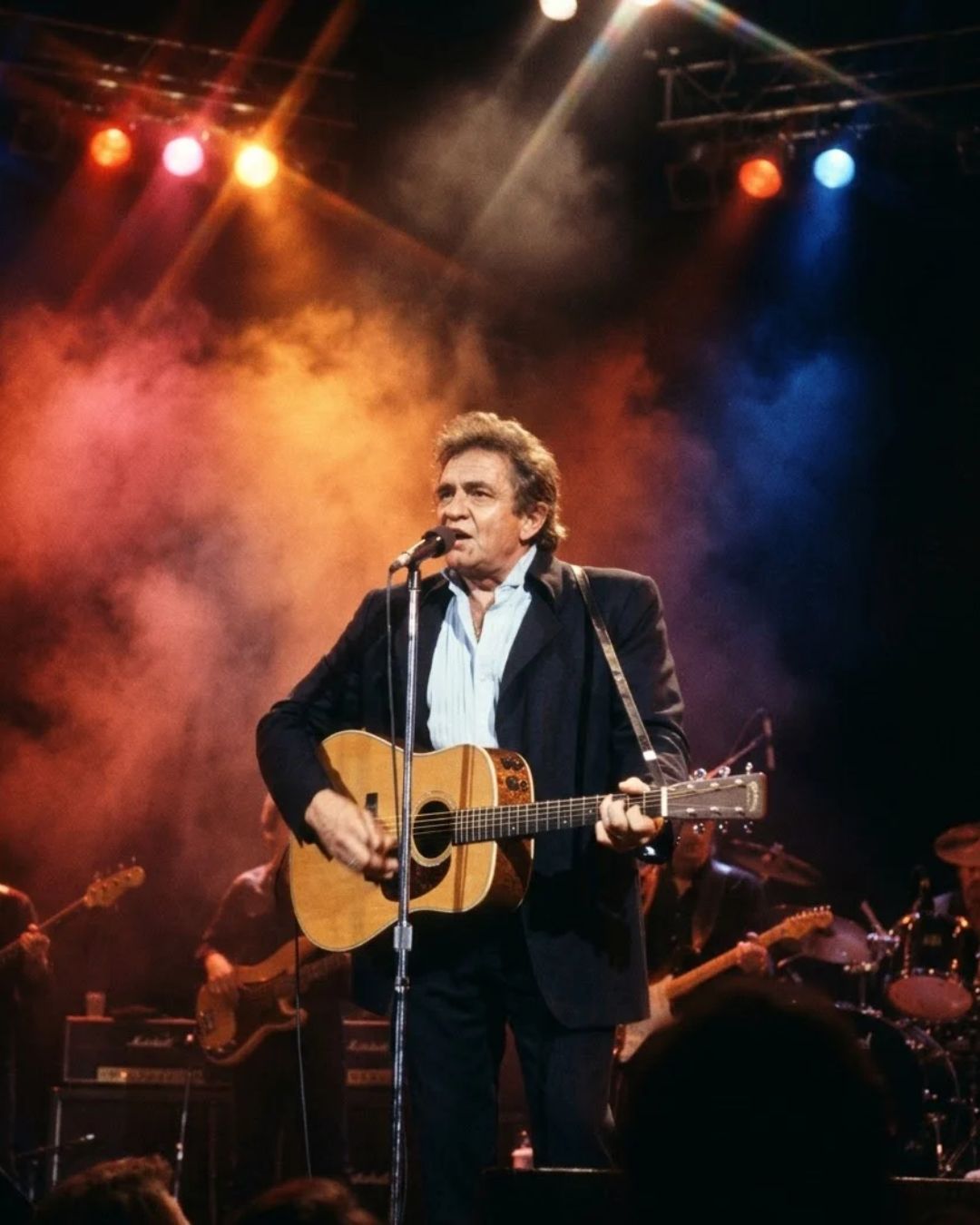
Stan Jones wrote the song in 1948. Accounts of its origins differ, but one widely told version says cowboy Cap Watts described seeing phantom riders driving storm clouds during a violent thunderstorm. Jones later worked as a National Park Service ranger in Death Valley, a landscape whose vast horizons suited the song’s supernatural scale.
Vaughn Monroe’s 1949 recording helped make the composition a popular standard. By the time Cash recorded it, the ballad’s imagery and story were familiar to listeners. His interpretation, included on the 1979 album “Silver,” gave the legend a distinctly darker cast.
A tale with consequences
Produced by Brian Ahern, the album featured Cash on vocals and guitar. Jan Howard and Carter Family members Anita, Helen and June provided harmony vocals. Their voices lend the refrain a communal, almost ritual quality, as if the story is being passed along rather than recalled by a single narrator.
Cash’s low, weathered delivery gives the supernatural scene the gravity of a witness describing something he cannot explain. A steady, hoof-like rhythm carries the song forward, while the guitar and harmonies keep it rooted in country tradition. The riders seem to be moving without reaching a destination, drawing the listener into their relentless passage.
That momentum supports the ballad’s moral dimension. The spectral herd and condemned riders turn the open sky into a place where actions have consequences and escape may not be possible. The warning to the living gives the spectacle its chill, even as the song gallops with the motion of an old Western tale.
The single reached No. 2 on Billboard’s country chart, showing that the legend still resonated in contemporary country music. Cash did not discard the original story’s clear, direct storytelling; he darkened its silhouette. The result holds adventure and judgment in uneasy balance, with the riders’ echo lingering overhead after the music stops.