Ernest Tubb heard the same problem from country fans as he toured: they could hear records on the radio, but often could not find them in local stores. In 1947, he answered with a Nashville record shop that sold other country artists’ music as well as his own—and shipped records to customers beyond the city.
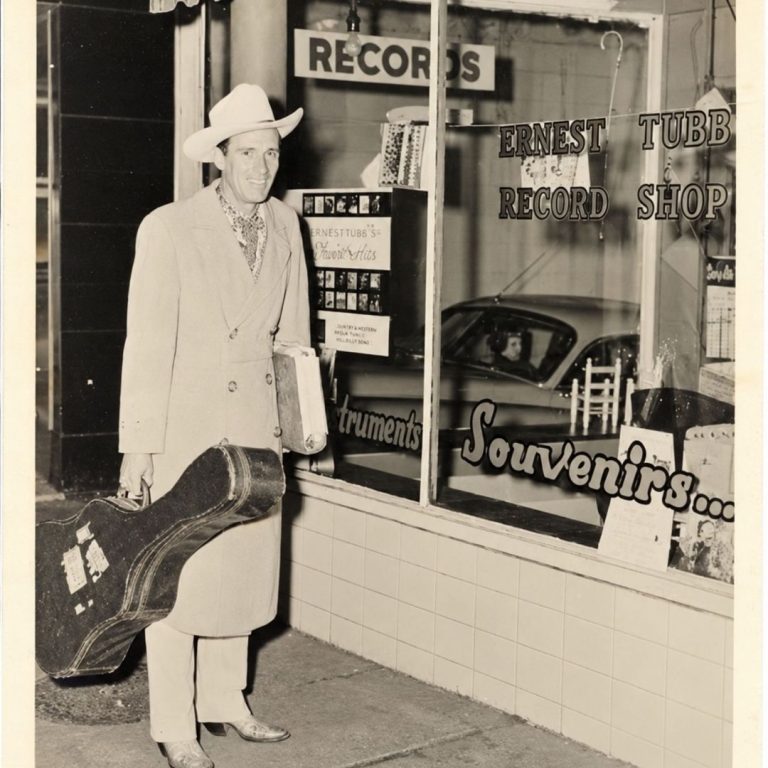
The shop addressed a gap between country music’s growing radio audience and the limited selection available in many towns. Tubb’s mail-order business let listeners buy records they had heard on the air without relying on a nearby retailer to stock them.
It also gave Tubb somewhere to keep performing after the Grand Ole Opry’s Saturday-night broadcast. The Opry’s crowded lineup left artists with limited time. Tubb began the Midnite Jamboree, a free, informal show broadcast on WSM after the Opry ended. In the store, musicians could play for a crowd close enough to stand among the record racks.
A stage after the Opry
The program served the shop’s commercial purpose: performers could promote records, and listeners could order them. But the arrangement also gave artists a place to play beyond the Opry’s tight schedule. Established performers sometimes brought younger singers, offering them exposure without guaranteeing a career or a hit.
In 1951, the shop moved from 720 Commerce Street to 417 Broadway, near the Ryman Auditorium. The new location made it easier for Opry visitors to walk over after the broadcast. The store became a meeting point for customers, musicians and fans, with the stage sharing space with the business that supported it.
Loretta Lynn appeared on the Midnite Jamboree while still promoting her first record, “I’m a Honky Tonk Girl.” Elvis Presley also visited the shop in 1954, after an Opry appearance. Accounts describe the 19-year-old speaking with Tubb about his ambition to sing country music. His later fame can make the encounter seem like a foregone conclusion, but at the time Presley was still a young regional performer.
The shop’s mail-order operation reportedly reached around 100,000 customers at its height, linking radio exposure to record sales across a broad area. The business and broadcast changed over time: the historic Broadway shop closed in 2022 and reopened under new ownership in a reworked form in 2025, while the Jamboree moved among locations.
Tubb’s lasting achievement was the connection he built between a store, a radio signal and a stage. The show helped sell records, but it also made room for country performers to be heard after the Opry had signed off.